
What to Have Ready Before a Regional Scent Preferences Call
The first call with a fragrance manufacturer is not a pitch and not a negotiation. It is a scoping conversation, and its only job is to find out whether the two sides are describing the same project. Buyers who arrive with a prep pack get a useful answer in thirty minutes; buyers who arrive with a feeling about a smell get a pleasant hour and a follow-up email that says very little. The preparation is not complicated, and most of it is material you already hold.
Key takeaways
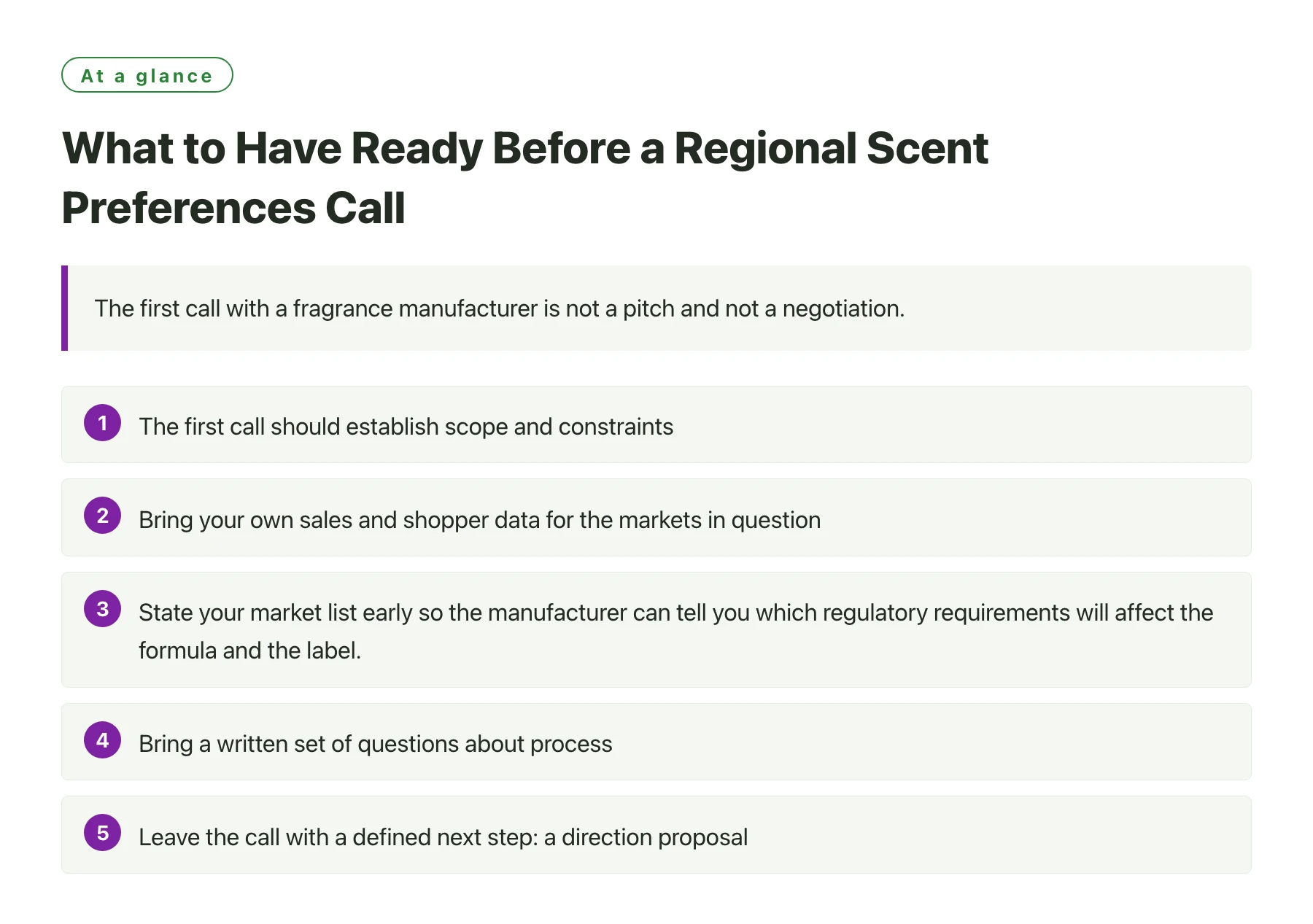
- The first call should establish scope and constraints, not choose a scent, so the agenda is the market, the format, the price tier and the date.
- Bring your own sales and shopper data for the markets in question, because it is the only preference evidence that reflects your stores.
- State your market list early so the manufacturer can tell you which regulatory requirements will affect the formula and the label.
- Bring a written set of questions about process, ownership and change control, and ask for answers in writing afterwards.
- Leave the call with a defined next step: a direction proposal, a sample plan, or a quotation structure, with dates attached.
Regional preference discussions go wrong in a specific way. The buyer describes a market with adjectives, the manufacturer responds with directions it has made before, and both parties leave believing they have agreed, when in fact nothing has been pinned down. Two weeks later the samples arrive, they are not what was meant, and the project has spent its first round on a misunderstanding that a structured call would have prevented.
This prep list is written for a pharmacy or drugstore own-label team that is about to speak to a manufacturer about regional scent preferences for the first time. It assumes no perfumery background and no prior sourcing experience, and it treats the call as a scoping exercise rather than a decision.
What the first call is actually for
A first call has four legitimate outputs: confirmation that the factory covers your formats and volumes, an understanding of how it develops a direction from a brief, a realistic view of the calendar and a clear next step. Choosing a scent is not one of them, and any conversation that starts with a smell on a strip is already too specific.
The agenda should therefore be short and factual. Which markets, which formats, which price tier, which volumes, which date is fixed. Every manufacturer will ask those five questions, and the buyer who can answer them controls the pace of the rest of the project.
It also helps to have looked at how the prospective partner presents itself before the call. A few minutes on Xuelei's website will show which categories and channels it works in, which means the call can start at the level of your project rather than at the level of a company introduction.
Finally, decide who is on the call. A single buyer with authority to answer questions is more useful than five people who each own a piece of the answer. If you must bring others, agree in advance who speaks to scope and who takes notes, because the notes are the deliverable.
The prep pack to assemble before you dial
| What to prepare | Why the factory needs it | How much detail is enough |
|---|---|---|
| Market list and channel | Regulatory requirements and labelling duties follow the market, and channel shapes the price tier | The countries you will sell in first, and whether the range is pharmacy, grocery or online |
| Your shopper and sales data | It is the only regional preference evidence tied to your own stores | Category sales, sell-through by format, and any returns or feedback you already hold |
| Format and pack | Format changes dosage, compatibility testing and filling method | One or two formats, pack sizes and whether you are open to stock packs for the first run |
| Price tier and target cost | It constrains the material palette more than any descriptive language | A retail band and a target cost per unit, stated as a range with your assumptions |
| Volume and date | Minimum order quantities and lead times are set by filling and packaging, not by the scent | A first-order quantity or an honest estimate, plus the date that cannot move and why |
| Claims and label needs | Claim wording and label content are decided before artwork, not after | Any claim you intend to make, and the markets where it has to hold |
| Your question list | It converts a conversation into evidence you can compare with other suppliers | Eight to twelve written questions on process, ownership, compliance and change control |
Assembling this takes an afternoon. It changes the call from a description of a wish into a scope discussion, and it gives the manufacturer enough to say something specific in return.
Preparing without a perfumer on staff
Nobody expects a pharmacy buyer to describe a scent in technical terms, and pretending to usually makes things worse. What a manufacturer does need is context: who buys the product, when they use it, what they currently buy instead, and what the pack has to communicate in the few seconds it gets at shelf. Those are commercial facts, not perfumery facts, and they are the ones you own.
Where a buyer can add real value is in the reference set. Bring three to five products you consider comparable, with a sentence on what you like or dislike about each. That gives the perfumer a concrete target and avoids the trap of adjectives that mean different things to different people.
The wider reading is worth an hour as well. Understanding what is involved in what it takes to launch a perfume brand makes it obvious which decisions are yours and which belong to the manufacturer, and it stops the call from drifting into questions the factory cannot answer for you.
Ask, too, how the manufacturer handles development when the buyer brings no formula. A factory offering their OEM/ODM manufacturing services is used to working from a direction rather than a recipe, and the useful follow-up question is who owns what is created.
One regulatory point is worth preparing in advance. Different markets maintain their own cosmetic requirements and ingredient provisions, so a market list is not just a commercial statement; it determines which rules the formula and the label have to satisfy, and a well-run supplier will ask for it before proposing anything [1].
End the call by asking for the next step in writing: a direction proposal, a sample plan with dates, or a quotation structure. If nothing arrives within the agreed window, that is information about the working relationship, and it is better to learn it now than after you have committed a launch date.
Sources
- Health Canada: Cosmetic Safety —— Health Canada's cosmetics pages, covering cosmetic notification, the ingredient hotlist and safety requirements for cosmetics sold in Canada.
Frequently asked questions
How long should a first call with a fragrance manufacturer take?
Thirty to forty-five minutes is usually enough for scoping. If it runs much longer without producing a next step, the conversation has drifted into detail that belongs in a written exchange.
Do we need to bring a scent reference to the first call?
Bring three to five comparable products with a note on each rather than a single target. A spread of references gives a perfumer more to work with than one bottle.
What if we do not know our volumes yet?
Say so, and give the range you are considering. Manufacturers set minimums from packaging and filling, so an honest estimate produces a more useful answer than a precise number you cannot hold to.
Should we discuss price on the first call?
Discuss the price structure rather than the price. Ask what is included in a unit price and what is quoted separately, and you will be able to compare quotes later without a second round of questions.
How many manufacturers should we speak to before deciding?
Three is a practical number. Fewer gives you no comparison, and more produces a long list of similar answers without improving the decision.