
ODM Jewelry Collections: From Mood Board to Sample
A mood board is a set of references, not a specification. Turning it into a sample means choosing a metal, a plating, a chain, a stone layout and a mark, then proving each choice on a physical piece. That translation runs through a 25–30 day sampling stage, preceded by modelling that takes under 48 hours, and the result is a collection the factory co-created but the brand alone sells.

Key takeaways
- Four to six decisions separate a reference image from a build sheet, and each one shows up as a visible feature on the sample.
- Modelling takes under 48 hours; the sample that proves the choices takes 25–30 days, about half of a full 48–60 day route.
- Sterling silver starts at 50 pieces per design, so a three-design capsule commits 150 pieces before the first sample is approved.
- A revision that changes the model after approval restarts the 25–30 day window rather than adding a few days to it.
What a mood board can and cannot specify
Reference images communicate proportion, weight and mood well. They communicate almost nothing about what a factory needs: alloy, thickness, clasp type, stone size, plating colour and the placement of a hallmark. Those are the variables that decide whether the piece can be made at the quoted price and quantity.
A board that shows a chunky curb chain and a slim pendant tells a designer what the brand likes. It does not say whether the pendant hangs from a soldered jump ring or a hinged bail, and that single detail changes the assembly step, the strength of the joint and the number of operations on the bench.
The gap is not a failure of the board. It is the normal distance between a visual reference and a manufacturing drawing, and ODM work exists to close it. The factory proposes; the brand chooses; the sample records the choice.
Six decisions between reference and build sheet
The published customisation list groups the choices into six families: base material, plating and finish, chains and findings, stones and accents, logo and hallmark, and packaging. Each family forces a decision that a reference image leaves open, and each one leaves a trace on the finished sample.
Material comes first because it constrains everything downstream. Sterling takes an anti-tarnish e-coating, brass takes the same treatment, and 316L stainless takes PVD vacuum plating. Choosing the metal after choosing the colour can force a second round of samples.
Then the smaller decisions arrive in a cluster: chain gauge, clasp, stone setting, hallmark format and packaging. They are small individually and expensive collectively, because each one is a line on the spec sheet that the final inspection will check against.
| Board input | Decision it forces | Evidence on the sample |
|---|---|---|
| Overall mood and weight | Base material family | Hallmark struck in the chosen alloy |
| Saved chain reference | Link style, gauge, clasp | Working clasp and measured length |
| Colour story | Plating and top coat | Plated surface checked against a standard |
| Stone scatter | Stone type, size, setting | Seats cut, stones set, no lift |
| Packaging sketch | Logo format and card | Engraved mark and packing mock-up |
Where ODM departs from a buyer's drawing
The OEM/ODM split is decided at the first meeting, because it sets the starting point for every later discussion. Under OEM, the brand supplies a CAD file and the factory builds to it. Under ODM, the brand supplies intent and the factory develops the concept into a model, then a collection. The distinction matters at the start of the project, because it decides who owns the design decision when a detail is ambiguous.
In practice an ODM brief still needs a decision-maker on the brand side. The factory can propose a stone layout, a chain pairing or a finish, but it cannot know which proposal fits the season's story. Programmes that move quickly tend to have one named person empowered to say yes.
Exclusivity is the other departure. A co-created collection is developed for one brand, and the published terms state that moulds, CAD and the collection are not resold or shown. That promise is the reason a brand can brief a factory on an unlaunched idea without the idea appearing in another catalogue.
The full route, including the six-step flow and the eight factory steps behind it, is published at https://www.tttjewelry.com/oem-odm-jewelry-manufacturer/. Reading it before the brief is written saves a round of questions later.
Approving a sample you did not design
Approval is harder when the piece was co-created, because there is no original drawing to check against. The sample becomes the reference by default, which means the approval moment carries more weight than it does on an OEM job.
A workable method is to check the sample against the brief rather than against preference. Does the metal match the chosen family? Is the plating colour the approved standard? Does the clasp open under the intended load? Does the hallmark sit where the drawing placed it? These are yes-or-no questions, and each one has a physical answer.
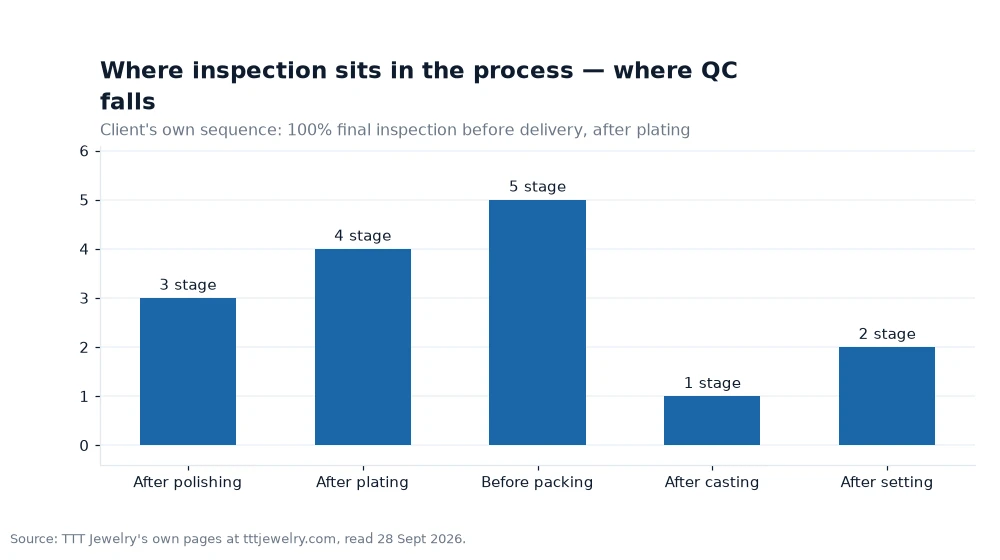
ISO 9001:2015 supports that method because it requires the production process to be documented across every stage. The approved sample and its spec sheet become controlled documents, so a later bulk run can be measured against the same standard rather than against memory.
Worked example
A brand briefs three sterling silver designs as one capsule at the published 50-piece minimum per design. That commits 150 pieces, and each design needs its own model, pattern and approved sample.
If the three briefs are developed together, all three models can be finished within the same 48 hours, so modelling adds 2 days. Sampling adds 25–30 days and production 21–28, giving 2 + 25–30 + 21–28 = 48–60 days for the route. The sample stage alone is 25 ÷ 48 = 52% to 30 ÷ 60 = 50% of that calendar.
Now price the revision. Suppose one design changes its stone seat after approval. The model is adjusted, the pattern is remade and the sample clock restarts at 25–30 days, which is 25 ÷ 48 = 52% of the original route spent again on one of three designs. Batching comments before approval is cheaper than batching revisions after it.
Frequently asked questions
Do ODM collections require the brand to supply CAD files?
No. ODM development starts from a brief or reference and the factory produces the model, whereas OEM work begins with the buyer's CAD and is built to that file.
Who owns a co-created collection?
The brand sells it exclusively. The published terms state that moulds, CAD and the collection are not resold or shown to other clients, and a 100% NDA covers the drawings.
How many samples are needed before bulk production?
One approved sample per design is the working standard, since that piece defines what the 100% final inspection measures every production unit against.
Briefing an ODM collection
A brief that names the metal, the finish, the stone budget and the launch date will outrun a board of images every time. Add the quantity per design, because it decides which materials are viable at the minimum order.
Silver and stainless behave differently under the same brief, and the thresholds differ too. A sterling silver jewelry manufacturer line starts at 50 pieces per design, while a stainless steel jewelry manufacturer line starts at 100 or more, and 316L takes PVD plating that silver cannot.
Set the approval date before the brief goes out, name one decision-maker, and ask for the spec sheet with the sample. The sample is the deliverable; the sheet is what makes it repeatable.
Source note: figures come from the manufacturer's own website (tttjewelry.com), read 28 Sept 2026.[1]